The article below is an interesting take on radiation and the current exposure guidelines.
The question of radiation explained in more detail.
Sunday, February 19, 2012


Tuesday, January 31, 2012
A word on Monsanto
Another perspective on Monsanto found and shared below:
http://naturalsociety.com/monsanto-declared-worst-company-of-2011/
http://naturalsociety.com/monsanto-declared-worst-company-of-2011/
Sunday, January 1, 2012
A farmer's fight with Monsanto

Monsanto, once an elegant family name, is nowadays a synonym of aggressive business strategies, malicious lobbying practices, seed commercialization, forceful litigation and questionable licensing agreements. All of the above made Monsanto a target of alter-globalization movement and environment activists.
Based on my observations, Monsanto remains relatively unknown to an average urban dweller in Europe. Hence, I will try to introduce the main facts and controversies concerning this leading multinational agricultural biotechnology corporation.
Briefly about Monsanto
Main products
1) GE (genetically engineered) seeds which are specifically genetically modified to make them resistant to Monsanto produced agricultural chemicals, such as "Round Up" herbicide.
2) Plant biotechnology traits
3) Crop protection chemicals - including globally used herbicide RoundUp
rBGH (recombinant Bovine Growth Hormone) - synthetic hormone injected into cows to increase milk production.
Globally Monsanto employs 21,035 staff in 66 countries.
Legal issues
Monsanto is notable for its involvement in high profile lawsuits, as both plaintiff and defendant. It has been involved in a number of suits, where fines and damages have run into the hundreds of millions of dollars, usually over health issues related to its products. Monsanto has received media coverage for its alleged unfair suing of farmers, highlighted in the documentary The World According to Monsanto.

Environmental record
Monsanto has been identified by the U.S. Environmental Protection Agency as being a "potentially responsible party" for 56 contaminated sites in the United States. Monsanto has been sued, and has settled, multiple times for damaging the health of its employees or residents near its those sites through pollution and poisoning.
Lobbying
The company spent $8,831,120 for lobbying in 2008.
Public officials formerly employed by Monsanto
- Justice Clarence Thomas worked as an attorney for Monsanto in the 1970s. Thomas wrote the majority opinion in the 2001 Supreme Court decision J. E. M. AG SUPPLY, INC. V. PIONEER HI-BRED INTERNATIONAL, INC. which found that "newly developed plant breeds are patentable under the general utility patent laws of the United States." This case benefited all companies which profit from genetically modified crops, of which Monsanto is the largest.
- Michael R. Taylor was an assistant to the Food and Drug Administration(FDA) commissioner before he left to work for a law firm on gaining FDA approval of Monsanto’s artificial growth hormone in the 1980s. Taylor then became deputy commissioner of the FDA from 1991 to 1994. Taylor was later re-appointed to the FDA in August 2009 by President Barack Obama.
- Dr. Michael A. Friedman was a deputy commissioner of the FDA before he was hired as a senior vice president of Monsanto.
- Linda J. Fisher was an assistant administrator at the US Environmental Protection Agency(EPA) before she was a vice president at Monsanto from 1995 to 2000. In 2001, Fisher became the deputy administrator of the EPA.

Intimidation
Since the mid-1990s, Monsanto has sued approx.150 individual US farmers for patent infringement in connection with its genetically engineered seed. The usual claim involves violation of a technology agreement that prohibits farmers from saving seed from one season's crop to plant the next, a common farming practice. The common practice employed by Monsanto is intimidation of farmers who often out of fear rather than anything else succumb to Monsanto's pressure in making a settlement.
However, there are success stories of farmers who had sufficient strength and resilience to confront Monsanto. One of them is Percy Schmeiser, a Canadian farmer who was accused by Monsanto of patent infringement. He eventually won the lawsuit against Monsanto.
The film based on Percy Schmeiser story by Bertram Verhaag 'DAVID VERSUS MONSANTO'.
Wednesday, December 7, 2011
Safer alternatives
Safer Alternatives

One thing I've noticed about human nature is that extremism can quietly sneak in through the back door once we make up our minds to follow certain ideas. Since I am a person who can certainly become slightly too extreme in my opinions I have recently taken time to re-evaluate some of my postulates regarding health and safety issues of cosmetic products. While my core beliefs haven't changed much, I realized that well-balanced compromise is almost always the most reasonable way out.
Hence, instead of campaigning for radical reduction of daily use of cosmetics, I am more likely to say: Women like to use make-ups and perfumes, and creams, and hair dyes and all sorts of other cosmetics, because among other things, it is fun to use them! And even in following a healthy lifestyle fun is as important as other things.
So I came across a few safer alternatives to beauty products which definitely make the whole business of looking after appearance more fun.
I. I am UNE.

UNE is a Parisian cosmetics house launched last year which prides itself for its green credentials, an extensive colour range and a manifesto that calls for enhancing, not concealing women’s inner beauty. Doesn't it sound great already? Well, they go even a step further.
Backed by Bourjois Paris’ centuries-long experience in makeup formulation, UNE offers products made from 98-100% natural, and if available, organic ingredients free of petrochemical mineral oils, paraben, silicon, and GMOs. The packaging is also designed for minimum impact on the environment.
UNE Brand Director, Sophie Dugue, explains the vision of UNE products: 'UNE is proposing the first “intuitive makeup”, as it offers essential colours, inspired by the natural colours of the skin, the hair, the eye’s iris and the lips. Therefore, whatever colour you mix, you will always have a harmony; it becomes impossible to fail with your make up!'

The best news is that UNE is available in some of the larger Boots stores. The colour range is truly amazing and mixing the colours is foolproof (tested on my own face :).
Apart from ethical and safety aspects of UNE, the products are attractive, affordable and not giving them a try would be comparable to loosing an interesting opportunity! So, why don't you give it a go?

II. Welcome to Urtekram
Body products CAN be organic, safe(r), ecofriendly, and free from synthetic preservatives and at the same time FUN and affordable. Urtekram, a company with eco credentials from Denmark, is a living proof :)
Since the 1970s, Urtekram has been producing pure and natural body and hair care products, and from the very beginning t has been aware that the body absorbs whatever we apply to it just like it absorbs whatever we feed it. Therefore, all Urtekram body and hair care products are:

* Free from hormonally active parabens and synthetic preserving agents.
* Made of vegetable ingredients (however, lip balm does contain beeswax).
* Free from petrochemical ingredients.
* A large selection of fragrance-free Urtekram products for children and adults are declared in cooperation with the Danish Asthma and Allergy Association.
*All raw materials must be free from pollution stemming from heavy metals, hydrocarbons, pesticides, dioxin, GMO (genetically modified organisms) and nitrate, and they must be processed by means of the simplest procedures possible.
And yet using Urtekram products is highly enjoyable. The Rose and Camomile shampoos smell wonderful and do their job very well. So do the soaps and toothpaste, though I still prefer Jason's SEA FRESH an all natural toothpaste for its much stronger minty taste.
III. Clay

I'm not an expert in Dr. Hauschka products, but I do like clay in many forms and used for many purposes. I came across Cleansing Clay Mask by Dr. Hauschka and use it as a natural way of cleansing my face. It's suitable for all skin types, it's especially beneficial for oily or blemished skin.
In this product finely ground clay is blended with extracts of nasturtium and witch hazel to form purifying and gently exfoliating mask. Impurities and skin secretions are drawn out and blemishes and blackheads are visibly reduced. The product lasts for ages so it's well-worth its price of 20euro or so :)
IV. Hair dyes can be safer too
 I resisted dying my hair for a long time despite the growing pressure from folks to do something about my grey hair. I don't necessarily see anything wrong with grey hair, but I do acknowledge that it made me look older than I really am. In other words, I gave in to the pressure and decided to test Daniel Field's organic and mineral haircare products. I wanted a product that will cover my grey hair and will be easy to apply. In the past I had been using SANTE hair henna (available in Dublin!), but the main problem was a very messy application of the henna, long time for the active ingredients to colour the hair and very poor coverage of grey hair. I still think this is a great product range if you don't need to cover any greys like in my case. SANTE henna actually strenghthened my hair and gave it a nice shine.
Coming back to Daniel Field, her products are formulated with the finest ingredients including high performance organic essential oils and non-genetically modified cereal oils and proteins. They offer gentler, safer alternatives which deliver hair in superb condition without compromise to style or colour. The ebony colour I chose looks natural and fresh on my hair.
V. Oils
By far the most popular oil on the market is so-called baby oil. Baby oil is nothing else than mineral oil which is a liquid by-product of the distillation of petroleum to produce gasoline and other petroleum-based products from crude oil.
Instead, there is a plethora of oils obtained from vegetable sources which can be safely applied to skin and hair. There are many wonderful oils available on the market, but I have two favourite ones which I have successfully popularized among friends.

Argan Oil and I - inseparable tandem

Argan oil is made from the nuts of the argan tree, which grows almost exclusively in Morocco. The oil is said to have restorative and age-defying effects. It is high in vitamin E and essential fatty acids, it is believed to help all sorts of skin conditions: dry skin, acne, psoriasis, eczema, wrinkles. Interestingly, argan oil remains one of the rarest oils in the world due to the small and very specific growing areas of the argan tree. I have been using it successfully on my oily skin instead of a cream and it does everything what I need: it keeps my skin well-nourished, soft, younger looking and it does not block pores.
Coconut oil - too simple to be true

Coconut oil is rich in fatty acids, which nourish and moisturize the skin and hair. Polynesian cultures historically have and still do use coconut oil as a beauty oil. A few studies found that coconut oil applied to the hair reduced hair breakage and damage. You can replace expensive deep conditioning salon treatments, by using coconut oil as a hair conditioner at home. Coconut oil can also be used as a very effective non-poreblocking face and body moisturizer. It keeps my previously troubled hands almost completely eczema-free.
Finale
This isn't an exhaustive list of safer alternatives to beauty products, but my subjective guide to some of them. I hope you find this article useful and encouraging to look for safer products which don't need to deprive women of the whole FUN of looking after their bodies and... souls!
Safer alternatives are available, but are usually not as strongly advertised as the mainstream products for obvious (financial!) reasons. Often humble looking beauty products can be far more beneficial than fancy looking popular cosmetics. Happy looking behind the labels!
 |
| Argan Oil Production in small Co-op's |
Sunday, September 18, 2011
Why choose an organic fabric?
I have been following this blog for a while and thought the authors provide very interesting and exhaustive information on textiles. Today's subject: why choose an organic fabric? I hope you will enjoy reading it.
http://oecotextiles.wordpress.com/2011/09/16/why-choose-an-organic-fabric/
http://oecotextiles.wordpress.com/2011/09/16/why-choose-an-organic-fabric/
Wednesday, August 24, 2011
Plastically Speaking - The Truth Behind Plastics Part II
Plastically Speaking - The Truth Behind Plastics Part II
How to Minimize your Exposure to Plastics

There are relatively simple ways of reducing your exposure to chemicals in plastics. As I mentioned in my previous post it's not possible to eliminate all plastics from our lives, therefore it's advisable to reduce your exposure to plastics where it matters most - mainly where plastics touch your food and mouth and are more likely to end up in your digestive system.
Here is some general advice on how to minimize potential toxicity of plastics which I compiled based on available literature:
1. With your food use plastics type #4 (LDPE), #5 (PP), #1 (PETE) and #2 (HDPE). Avoid #3 (PVC), #6 (PS) and #7 (other).
2. Use alternatives to plastic packaging whenever possible.
3. Don't microwave food in plastic containers even if they claim to be 'microwave safe'. Heat can break down plastics and release chemical additives into your food and drink. Ceramic or glass food containers (like Pyrex) are better to store and heat your food and drink.
4. Don't use cling wrap (which is made of PVC) in a microwave. Use a ceramic plate or paper towel instead. If you do use plastic, don’t let the plastic touch the food.
5. Don't used plastic containers for hot, fatty or highly acidic food as there is greater leaching of chemicals into these foods.
6. Avoid old, scratched food plastic containers. Exposures to plastics chemicals may be greater when the surface is worn down.
7. Don't reuse single-use plastics. They can break down and release plastics chemicals when used repeatedly.
8. Wash plastics on the top rack of the dishwasher, farther from the heating element, or, preferably, by hand. This will reduce wear and tear.
9. When using an electric mixer, choose glass or Pyrex instead of plastic to avoid chipping bits of plastic into your food.
10. Use wooden cutting boards -- but care for them properly to minimize bacteria.
Why plastic bottled water is such a bad idea

Avoid plastic bottled water unless you are travelling or live in an area where the quality of water is questionable. Bottled water, because it is less regulated, has less-certain purity and safety than tap water, and is much more expensive. It's generally a good idea to install a home water filter or use an inexpensive filter pitcher instead of buying bottled water. This way you will have much purer, healtier and less expensive water. You will also contribute to reducing landfill waste and exposure to chemicals that leach from the plastic. Remember that plastic bottled water is yet another brilliant business idea which seems to have taken over most of the well-developed countries. Use safer alternatives when you need to take water with you such as a glass or stainless steel bottle without plastic or epoxy lining. If you use a polycarbonate (#7) water bottle in order to reduce leaching of BPA, do not use it for warm or hot liquids and discard old or scratched bottles. Water bottles from #1 or #2 plastics are recommended for single use only. Avoid leaving plastic bottled water in direct sunlight in places like your car or a balcony as it will increase leaching of the chemicals into the water.
Safer Alternatives for Kids

 Many baby bottles are made from polycarbonate plastic #7 (which can potentially leach BPA into baby food), including leading brands such as Avent, TommeeTippee and some DrBrown bottles. These bottles are usually clear and hard. Fortunately, there are more and more baby bottles made from #5 (PP) which are pliable and more milky-coloured. The brand which I favour is Medela, but there are many other good brands which produce safer alternatives to polycarbonate bottles. Avoid bottles, sippy cups, training cups and many others made of polycarbonate plastic at all costs and substitute them with glass bottles or made of #5 plastic (PP).
 It's not advisable to pour boiling water into plastic feeding bottles. Prepare the mixture in a safe container such as a ceramic or glass bowl and transfer it to a plastic bottle once it's cooled down.
 Give your baby natural teethers like frozen washcloths or natural, uncoated wood. Plastic teethers could have harmful additives that leach when chewed. Don't allow your baby or young child to handle or chew on plastic electronics (the remote, your cell phone) because they may be treated with fire retardants.
Look for toys made of natural materials, like wool, cotton, and uncoated wood. While phthalates were recently banned in new children's toys, they may be found in older toys before the ban went into effect, as well as in shower curtains, inflatable beach toys and raincoats.
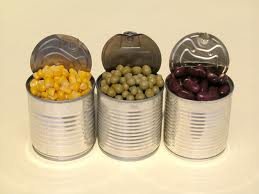
Why canned food is definitely not good for you
As I mentioned in part I, Bisphenol A (BPA) is a controversial chemical used in polycarbonate plastic containers #7. Its toxicity involves mimicking certain hormones which can lead to serious health consequences (please see my previous post). When I had my baby 4 years ago, the only available BPA-free feeding bottle on the Irish market was Medela's breastfeeding storage bottles. Currently the choice is much wider which suggests that things are changing for better. Due to increasing consumer awareness more and more manufacturers offer their food products in plastic containers which don't contain BPA.
Unfortunately, majority of mainstream canned foods are packaged in metal cans which are lined inside with BPA. Due to certain food processing procedures invloved in manufacture of canned foods, BPA leaching into foods is much higher than in beverages in polycarbonate bottles #7. Therefore, there is a growing support for removing BPA from metal cans lining. Currently new alternatives to BPA are being researched which could prove to be equally versatile and economically viable. In the absence of such widely available safer alternatives, it's wise to avoid all canned foods. Moreover, canned foods are nutritionally inferior to fresh foods.
Although current general scientific advice on BPA in food containers is that leaching of BPA into foods is not significant enough to cause any adverse health problems, many NGO organizations warn that precaution should be exercised in relation to this potent toxicant.

Tuesday, August 23, 2011
Plastically Speaking - The Truth Behind Plastics Part I

Over the last few decades plastics have invaded our homes. From my observation few people seem to be concerned about their rather overwhelming presence, which, I think, is due to the fact that public awareness of how potentially harmful plastics can be is very little. Most of us don't really know what plastics are made of and whether they are safe.
Health Concerns with Food Use of Plastics
The toxicity of plastics is not fully understood and adequately tested. A plethora of petroleum-based chemicals are used in the manufacturing of plastics. Certain chemical additives, used in order to change the qualities of plastics such as their softness or resistance to UV light, have been proven to be harmful. They include bisphenol-A and phthalates which are potent hormone disruptors that are increasingly linked to health effects like brain and behavior changes, cancer, and reproductive system damages.
Some chemicals can leach into food and drinks and possibly impact human health. Leaching increases when plastic comes in contact with oily or fatty foods, during heating and from old or scratched plastic. Types of plastics shown to leach toxic chemicals are polycarbonate, PVC and styrene. This does not imply that other plastics are entirely safe. These plastics have just been studied more (source: Institute for Agriculture and Trade Policy available at www.iatp.org).
Although most of the chemicals used in food containers are considered "safe," that's generally not because they've been proved safe, but rather they haven't been proven to be unsafe. (source: Environmental Working Group available HERE).
Environmental Concerns Associated with Manufacture and Use of Plastics

Most plastics are made from petroleum, a non-renewable and mostly imported resource. Plastic packaging also creates unnecessary bulky waste which takes up a large volume of landfill space.
Plastic manufacturing and incineration creates air and water pollution and exposes workers to toxic chemicals.
Plastic manufacturing and incineration creates air and water pollution and exposes workers to toxic chemicals.
Commonly Used Types of Plastics As Food Containers

1 - PETE
Polyethylene terephthalate ethylene, used for soft drink, juice and water containers
2 - HDPE
High density polyethylene, used in opaque plastic milk and water jugs and some plastic bags.
3 - PVC or V
Polyvinyl chloride, used for cling wrap, some plastic squeeze bottles and cooking oil.
A reson for concern! DEHA(di(2-ethylhexyl)adipate) is one of several plasticizers (softeners) to which people have daily exposure through food, water, air and consumer products. PVC cling wrap contains DEHA, which can leach into oily foods on contact and when heated. DEHA exposure can adversly affect liver, kidney, spleen, bone formation and body weight. It is also a possible human carcinogen.
4 - LDPE
Low density polyethylene, used in grocery store bags, most plastic wraps and some bottles.
5 - PP
5 - PP
Polypropylene, used in most Rubbermaid, deli soup, syrup and yogurt containers, straws and other clouded plastic containers, including baby bottles.
6 - PS
Polystyrene, used in Styrofoam food trays, yogurt containers, disposable cups and bowls, carry-out containers and opaque plastic cutlery.
A reason for concern! STYRENE can leach from polystyrene plastic. Styrene is toxic to the brain and nervous system, among workers with longer-term exposures,15,16 but also has been found to adversely affect red blood cells, liver, kidneys and stomach in animal studies.17 Aside from exposure from food containers, children can be exposed to styrene from secondhand cigarette smoke, off-gassing of building materials, auto exhaust fumes and drinking water.
7 - Other
Usually polycarbonate, used in most plastic baby bottles, 5-gallon water bottles, "sport" water bottles, metal food can liners, clear plastic "sippy" cups and some clear plastic cutlery. New bio-based plastics may also be labeled #7.
A reason for concern! Bisphenol A (BPA) is a chemical that mimics the action of the human hormone estrogen and can leach from polycarbonate plastic.A Centers for Disease Control study detected BPA in the urine of 95 percent of adults sampled. Health Effects of Exposure to BPA can be serious. Hormonal imbalance caused by BPA can stimulate certain cancers. BPA can cause chromosomal errors at low levels of exposure in mice, which can lead to spontaneous miscarriages and birth defects. One study found that women with recurrent miscarriages had threefold higher levels of BPA in their blood than women without miscarriage history. Of 115 published animal studies, 81 percent found significant effects from even low-level exposure to BPA. While none of the 11 industry-funded studies found significant effects, over 90 percent of government-funded studies did so. (Source Smart Plastics Guide by The Institute for Agriculture and Trade Policy available at www.iatp.org).
BPA can also cause early onset of puberty, and stimulation of mammary gland development in females, changes in gender-specific behavior, decreased sperm production, altered immune function, behavioral effects including hyperactivity, increased aggressiveness, impaired learning and other changes in behavior.
Children and Plastics
I cannot stress enough that children are more vulnerable to toxic exposure due to their immature immune systems, rapid development and different eating patterns. Long term exposures to certain chemicals found in plastics or a few large exposures at a critical time in development could adversely impact children’s health.
Choose and Use Safer Plactics Where It Matters Most
Because plastics are ubiquitous it's not possible to eliminate them altogether from our daily life. It's advisable then to focus on minimizing exposure where it matters most, namely on plastics which come into contact with food. In my next post I will explain in more detail how to use plastics more safely.

Subscribe to:
Posts (Atom)